Why this question matters
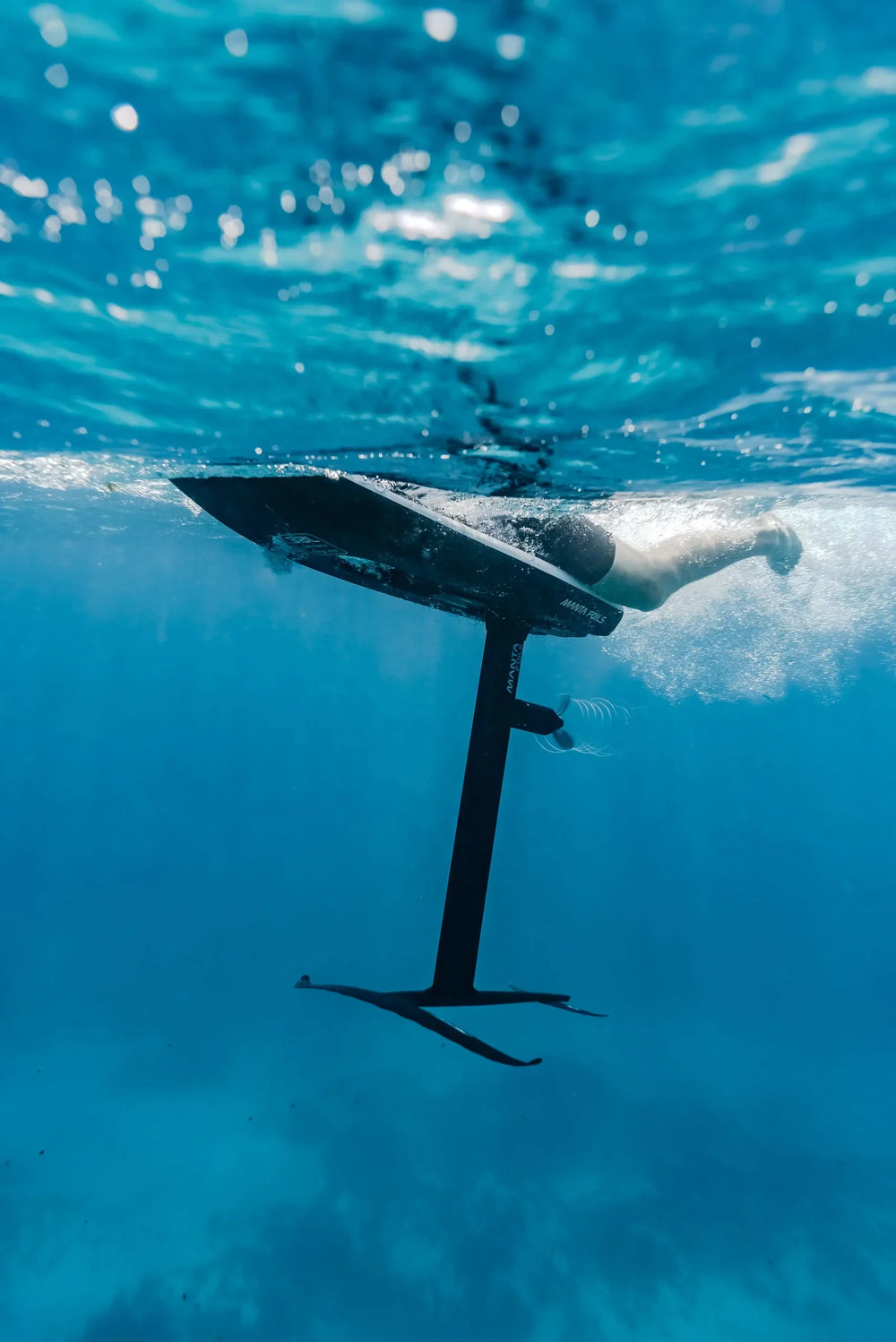
Every foil assist has three parts: a motor on the mast, a battery, and a way to switch it on and off. The motor always lives on the mast. The battery is the heavy part, and brands disagree about where it belongs.
Some put it under or on the board. Some put it on a harness or backpack you wear. Our article Why We Chose Manta covers the market and the brands. This one is about the riding: what each setup feels like on the water, and the everyday physics behind that feeling.
The physics, in plain English
You don't need equations to understand this. Three ideas cover almost everything.
1. Total weight doesn't change, so take-off doesn't change much
Your foil makes lift to hold up everything: you, the board, the foil and the battery. Say you weigh 80 kg, your board and foil weigh 10 kg and your battery weighs 2.5 kg. The foil has to carry 92.5 kg whether the battery is on your hips or on the deck. (2.5 kg is the Manta TakeOff Evo main unit with one Air battery; the board and foil figure is an example.)
So the speed you need to get flying, and the power the motor uses to get you there, are about the same in both setups. The difference is in how the kit responds once you're up.
2. Your legs are the suspension
When you ride a foil, your legs work like the suspension on a mountain bike. They let the board move up, down and side to side underneath you while your upper body stays fairly still.
Anything strapped to your body sits above the suspension. Anything bolted to the board sits below it, and moves every time the board moves.
Car designers call weight below the suspension "unsprung weight", and they try hard to keep it low, because a heavy wheel is slow to follow the road. A foil board is the same. A heavier board is slower to follow what your feet ask of it.
3. Heavy things are harder to start and stop
A heavy object takes more force to speed up, slow down or change direction. That's Newton's second law, and you already know it from pushing a full shopping cart versus an empty one.
In the example above, adding a 2.5 kg battery to a 10 kg board and foil makes the part your legs are moving 25% heavier. Your legs feel that 25% on every pump and every turn.
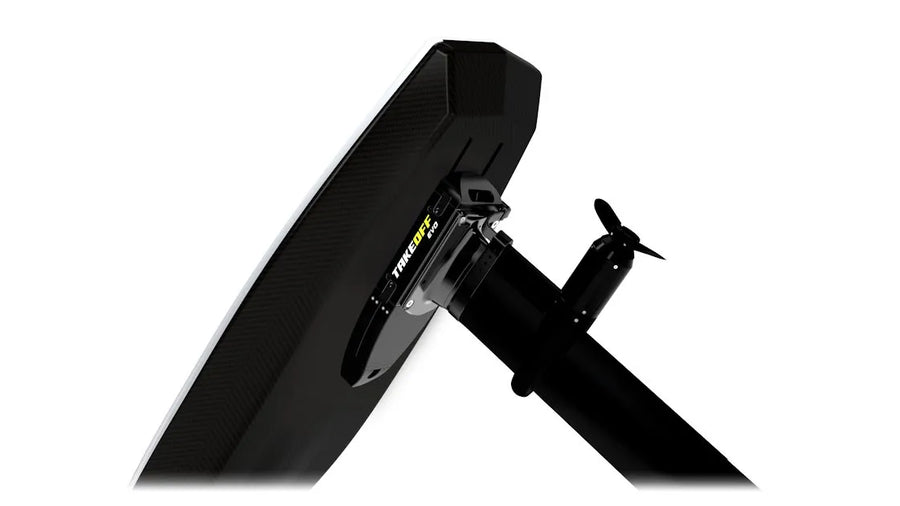
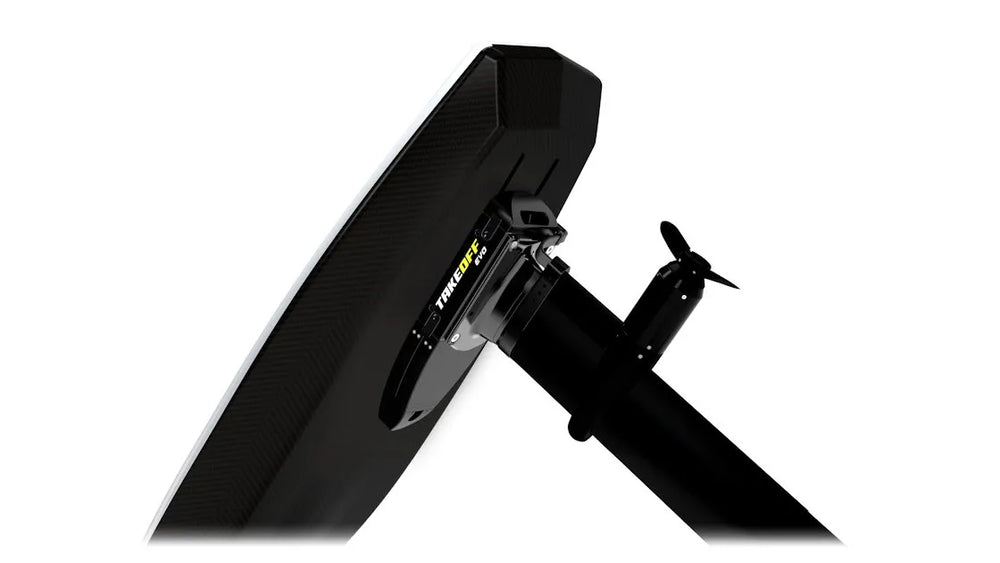
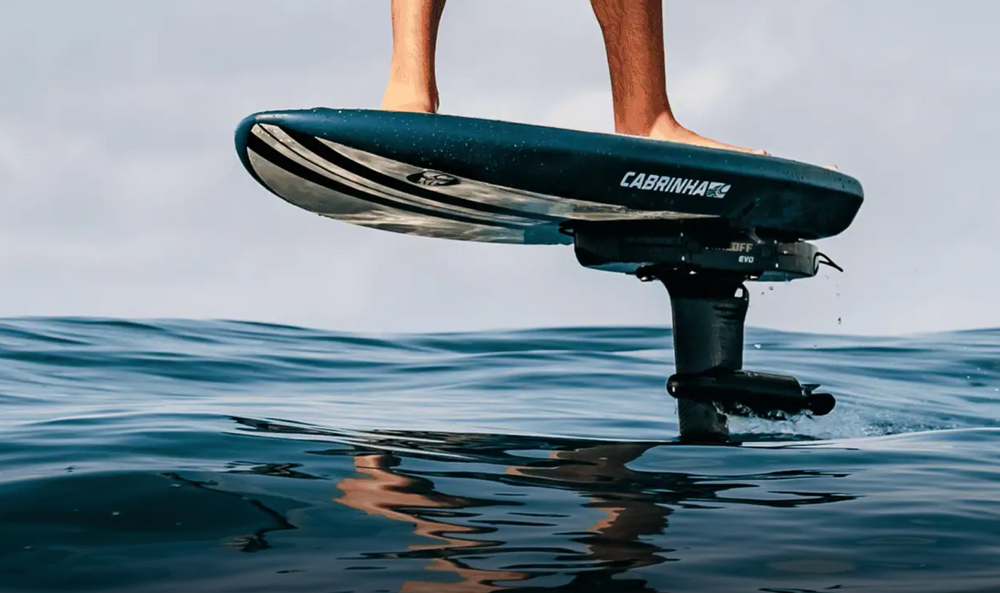
There's one more detail. How far the weight sits from the point the board pivots around matters too. A hammer is easy to swing if you hold it near the head, and hard if you hold the end of the handle. Weight close to the mast is easier to turn than the same weight near the nose or tail. On Manta TakeOff Evo, the main unit sits directly between the board and the mast, so its weight is right over the pivot point.
How it feels: battery on the board
Pumping. This is where riders notice it most. Every pump pushes the board down and lets it rise, so a heavier board takes more effort each stroke. Riders describe board-mounted setups with larger batteries as less responsive. One review of a board-mounted kit said the bigger battery "noticeably increases the overall weight, impacting reactivity during transitions." (Ride Evolve review of Foil Drive Assist MAX)
Turning and transitions. Carves, cutbacks, tacks and gybes ask the board to change direction quickly. Extra board weight makes those moves a little slower and heavier underfoot.
Stability. The flip side of a slower board is a calmer one. Extra board mass smooths out small chop, and some riders find it reassuring while learning. (This is our reading of the physics and rider talk, not a measured result.)
Falls and carrying. A heavier board is harder to flip over, haul back up onto in the water and carry up the beach. It also sits a little lower in the water.
Simplicity. You carry nothing. No harness, no cable across your body, nothing to put on before you paddle out. For many riders that freedom is the deciding factor.
How it feels: battery on your body
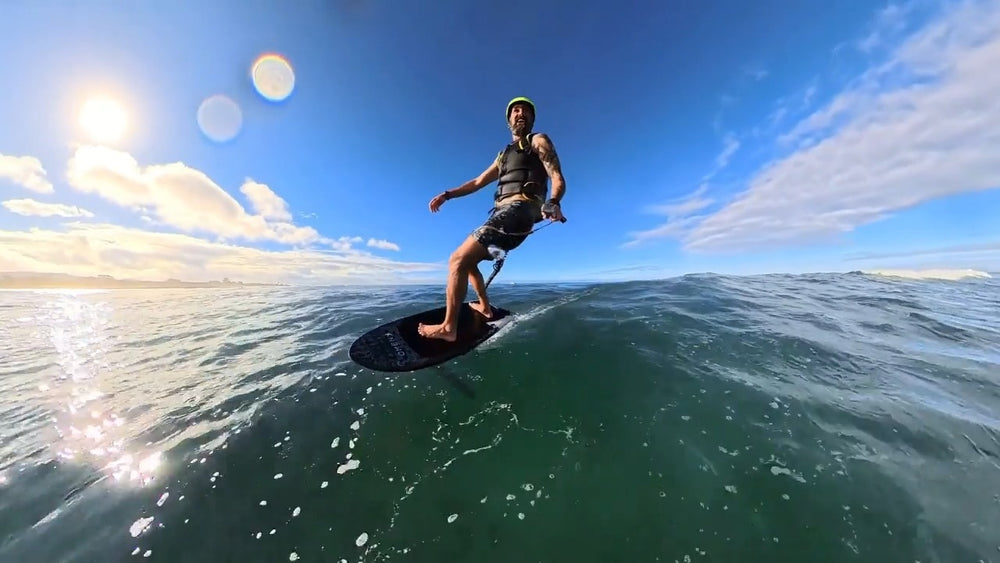
Pumping and liveliness. With the battery off the board, the board goes back to close to its normal weight. That's the main reason to wear it. A MACkite review of Manta TakeOff Evo says that with the batteries in the backpack "you take all that weight off the board", and the setup feels "much more lively." (MACkite review)
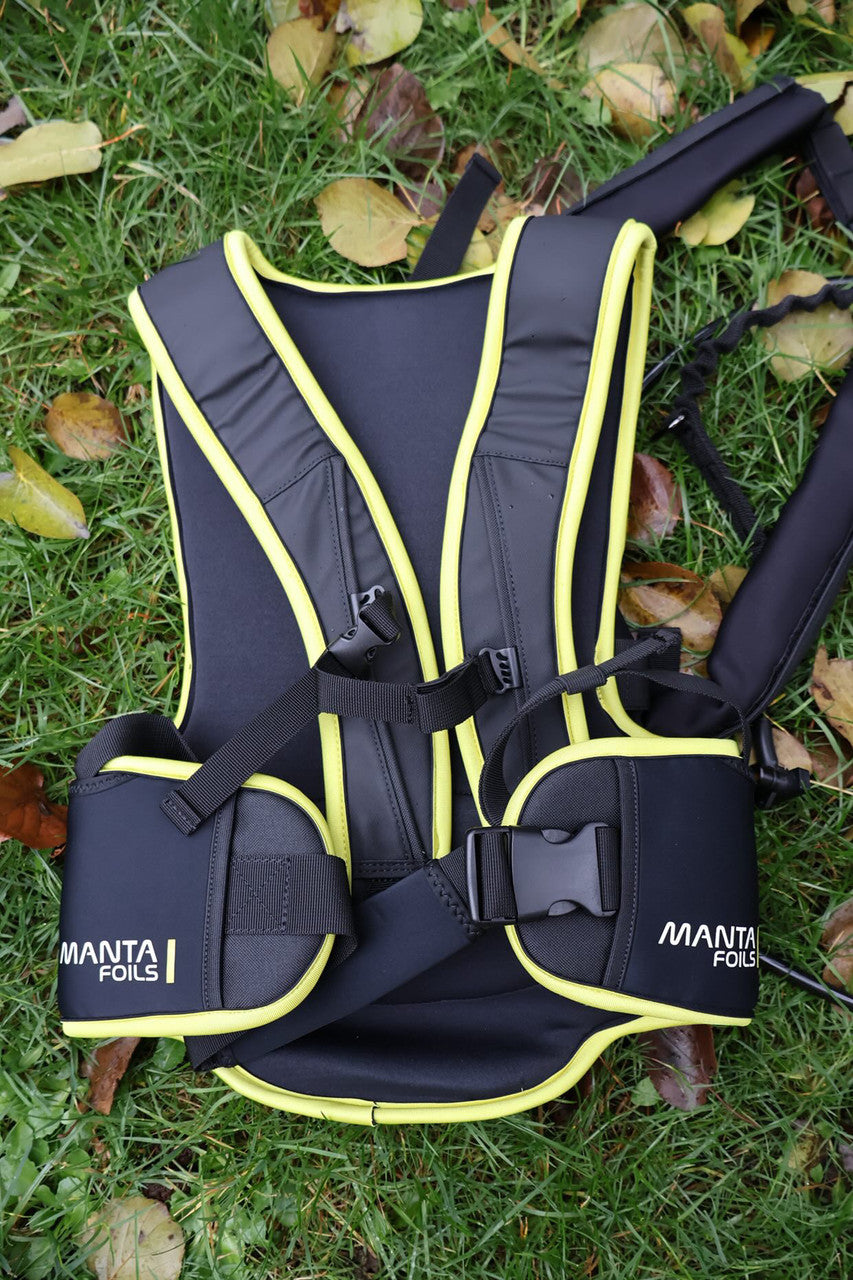
Balance. Weight on your hips sits close to your own center of gravity, so most riders barely notice it once they're flying. Duotone, which builds a waist harness system, says the weight "sits on the hips, where it does not affect your balance." (Duotone eHarness) Weight higher up, in a backpack like Manta's, raises your center of gravity a little and loads your shoulders.
Wearing it all session. You carry the battery while paddling, swimming and duck-diving, not just while flying. Riders who spend a lot of time in the water, like proners in the impact zone, notice this most.
The cable. A cable runs from you to the motor, usually alongside a leash. Riders on forums talk about how it needs some stretch to survive wipeouts and about where to attach the leash. (foil.zone thread) Good wearable systems have a quick release so you can get free in the water. With the Manta Backpack, the power cable runs along the leash, and Manta says to keep the leash shorter than the cable.
Swapping boards. Because the battery isn't built into the board, moving your foil assist from one board to another is usually easier.
Side by side
| Battery on the board | Battery on your body | |
|---|---|---|
| Weight the foil lifts | Same | Same |
| Board feel | Heavier, steadier, slower to react | Light and lively, close to normal |
| Pumping effort | Higher | Lower for the board, you carry the weight instead |
| Turns and transitions | A little slower | Quicker |
| In the water, falls, swimming | Heavier board to flip and carry | You swim with the pack on |
| Kit on your body | Nothing | Harness or pack, cable and leash |
| Best suited to | Simple sessions, learning, riders who want nothing on them | Pumping, linking bumps, wave riding, frequent board swaps |
Which suits your riding?
- Prone and wave riding. Pumping and quick turns matter most, so a light board pays off. Wearing the battery is the natural fit, as long as you're happy carrying it in the water.
- Downwind foiling. Linking bumps is pumping by another name, so board weight matters. On long runs, though, some riders prefer to carry nothing on their body. Try both if you can.
- Wing foiling. You're already handling the wing with your arms and upper body. Weight on the hips is usually fine, and the board-mounted setup keeps your body completely free. New to winging? Start with our introduction to wing foiling.
- SUP foiling and learning. A steadier board and nothing to wear make board-mounted the easy starting point. Still learning? Read how hard it is to learn foiling.
Your choice may change with the day. A light board for a pumping session, a big battery on the deck for a long cruise. That's why we like a system that does both. For how foil assist helps each discipline, see Who Is Foil Assist For?
Why Manta TakeOff Evo covers both
Most foil assist systems choose one answer. Under-board kits keep the battery on the board. Harness kits keep it on you.
Manta TakeOff Evo uses slot-in batteries that fit the power unit on the board, in sizes from the light Air battery (194 Wh, splitting into two 97 Wh halves for travel) up to the Endurance battery (518 Wh). (MACkite review) For riders who want the board light, the Manta Backpack carries the battery and main unit on your back instead, with a cable down to the motor and an interface plate between mast and board. Pakaʻa Foil sells and supports both setups.
That means one foil assist kit can follow you from a pumping session on a small board to a long downwinder, without buying a second system. At 3,500 W, it also has the highest-rated motor of any commercial foil assist right now. For the full comparison with other brands, see Why We Chose Manta: The State of the Foil Assist Market in 2026.
Already own a Foil Drive? Take the weight off the board
You don't need a new system to try body-mounted foil assist. The Manta Backpack comes in a Foil Drive version, with a Foil Drive power cable, a leash and an interface plate. Your Foil Drive unit goes in the backpack, the motor stays on your mast, and your board drops back to close to its normal weight, so it's lighter to pump, turn and pick up.
It's a simple way for Foil Drive owners to feel the difference this guide describes, and to switch back to board-mounted whenever you like. Not sure it suits your setup? Text us on 808-278-0650 and we'll check.
Frequently asked questions
Does a foil assist battery on your body make you heavier on the foil?
No more than it would on the board. The foil carries the same total weight either way. What changes is how heavy the board itself feels when you pump and turn.
Is it better to have the foil assist battery on the board or on your back?
On the board is simpler and steadier, with nothing to wear. On your body keeps the board light and lively for pumping and turning. Many riders pick by discipline: body for prone and pumping, board for easy sessions.
Can I wear my Foil Drive on my back?
Yes, with the Manta Backpack in its Foil Drive version. It comes with a Foil Drive power cable, so your Foil Drive unit rides on your back instead of under the board.
Does board weight make pumping harder?
Yes. Every pump moves the board up and down, and a heavier board takes more force to move. A 2.5 kg battery on a 10 kg board and foil adds about a quarter to what your legs are moving.
Is a wearable foil assist battery safe in a wipeout?
Good systems use a cable with some stretch and a quick release, and some harnesses float. Check how the system releases before you ride. Manta's backpack manual asks for a strong leash plug and a leash shorter than the power cable. Riding near other people? Read our foil assist etiquette guide.
Can Manta TakeOff Evo be used with the battery on the board and on the body?
Yes, the batteries can sit in the power unit on the board or be worn in the Manta Backpack. Pakaʻa Foil sells and supports both setups, with Air and Endurance batteries.
Does battery position change how long the battery lasts?
Not much. The motor lifts the same total weight either way, so run time depends mainly on battery size, rider weight and how often you restart. Manta rates the TakeOff Evo at 15 to 20 minutes of continuous motor time on one Air battery, and up to 65 to 70 minutes with an Air and an Endurance battery.
Try both at Pakaʻa Foil
The best way to know which you prefer is to ride both. Pakaʻa Foil stocks the Manta TakeOff Evo and supports both setups, on the board or in the Manta Backpack, with every battery from Air to Endurance. We're on the South Shore of Kauaʻi, where we run foil assist lessons, so you can try it on the water first. Not on Kauaʻi? We ship from Charleston, South Carolina. Talk to us about your board and riding, and we'll help you choose. Text us on 808-278-0650 (text is best, and it's how to book a lesson) or use our contact form. You can also browse all our foil assist kits, or read the foil assist FAQ for more.